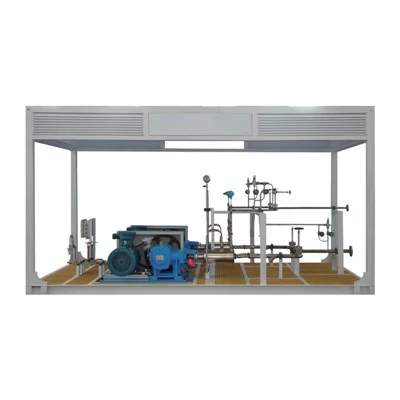
If you’ve ever stood at a remote worksite at 2 a.m., watching a fleet of heavy-duty construction idling because its fixed LNG fueling station is 80 miles down a single-lane dirt road, you know the pain point that keeps us up at night. For years, the LNG fueling industry relied almost entirely on fixed, permanent fueling stations—large, concrete structures bolted to the ground, requiring months of permitting, site prep, and six or seven-figure upfront investment. But over the past decade, as industries from construction to maritime to long-haul trucking have shifted to cleaner LNG to meet emissions targets, a quieter revolution has unfolded: mobile LNG refueling equipment. As a supplier of this gear, I’ve seen firsthand how it solves problems fixed stations never could, and how it’s not just a stopgap—it’s the future of flexible, scalable energy logistics. LNG Refueling Equipment

Let’s start with the biggest headache for any fleet or project manager: site access and timelines. Fixed LNG stations aren’t plug-and-play. To build one, you need zoning permits that can take six to 18 months to secure, environmental impact studies that account for pipeline connections and storage tank placement, and specialized construction crews that know how to handle cryogenic LNG infrastructure. Then there’s the site prep itself: grading, paving, electrical work, and safety systems that have to meet strict national fire and code standards. For a mid-sized construction firm with a 24-month highway expansion project, that’s a huge ask—especially when the project’s footprint is constantly shifting, moving from one stretch of road to another, or between remote mountain sites. Mobile LNG refueling equipment cuts that timeline to days, not years. Our units come fully assembled, tested in our factory to meet all safety and performance specs, and arrive on-site ready to connect to a temporary power supply and fuel your fleet within 72 hours. No grading, no permits beyond a basic temporary use permit for most locations, no waiting for pipeline construction to reach a remote site. I had a client last year with a wind farm project in central Wyoming, 120 miles from the nearest fixed LNG station. They needed to fuel 40 semi-trucks and 20 heavy excavators within two weeks of breaking ground. A fixed station would have taken 10 months to get approved and built. We deployed three mobile refueling units, each with a 5,000-gallon cryogenic storage tank and a dual hose dispensing system, and they were up and running in 48 hours. That kind of flexibility isn’t just convenient—it’s makes projects financially feasible that would otherwise be delayed or cancelled.
Next, there’s scalability, which is a game-changer for every industry that uses LNG. Fixed stations are built for a specific volume of fuel, with storage tanks sized to match a fleet’s average usage. But what happens when your project ramps up? Say you have a 100-truck fleet that grows to 200 trucks mid-project, or a maritime vessel that only needs LNG during its peak shipping season. Expanding a fixed station requires adding new storage tanks, modifying dispensers, and re-running safety audits—costing tens of thousands of dollars and weeks of downtime. Mobile LNG equipment lets you scale up or down in a matter of days. Our units come in a range of sizes, from 1,000-gallon trailers for small construction crews to 20,000-gallon units for large fleets or maritime operations. If your usage spikes, we can deploy an additional unit to your site in 24 hours. If you finish a project early, you can return the unit to us for reconditioning and redeployment, avoiding the sunk cost of a fixed station that you’ll never use again. I learned this lesson early on with a long-haul trucking client in Texas. They started with a 5,000-gallon mobile unit to fuel 30 trucks, and as their route expanded to include cross-country runs, we added two more 10,000-gallon units to cover their peak summer shipping season. By the end of the year, they’d cut their fueling costs by 18% compared to using multiple fixed stations along their route, and avoided the $200,000 cost of building a fixed station that would only be utilized 60% of the time.
Safety is another area where mobile LNG equipment outperforms fixed stations, if it’s designed and built properly. Cryogenic LNG is stored at -260°F, so handling it requires strict safety protocols, but mobile units are engineered with these risks in mind, and often have safety features that fixed stations don’t. First, because mobile units are only on-site for the duration of a project or a peak period, they don’t have permanent exposure to environmental risks like tornadoes, wildfires, or vehicle collisions that can damage fixed infrastructure. Our units are built to withstand extreme weather—they’re mounted on heavy-duty trailers with reinforced frames, the storage tanks are wrapped in multi-layered vacuum insulation that prevents temperature fluctuations, and all hoses and connections are pressure-tested before every deployment. They also have built-in safety systems: automatic shut-off valves that trigger if there’s a leak, gas detection sensors that alert operators to even trace amounts of LNG vapor, and over-pressure relief valves that prevent tank damage. Unlike fixed stations, which often have multiple operators and bystanders on-site at all times, mobile units are typically operated by a single trained technician, reducing the number of people exposed to cryogenic risks. We also provide full operator training with every unit deployment, so clients’ teams know exactly how to handle the equipment, respond to emergencies, and maintain it properly. Last year, one of our units was on-site at a port in Louisiana when a sudden storm knocked over a nearby construction crane. The crane missed the mobile LNG unit by 15 feet, but our reinforced frame and safety systems held up without any damage or leaks. A fixed station in that same area would have likely suffered significant damage, leading to weeks of downtime and costly repairs.
Cost is probably the biggest advantage that keeps clients coming back to mobile LNG equipment, especially when you factor in total cost of ownership (TCO). Let’s break it down: fixed stations require upfront investment in land, permits, construction, and pipeline connections—we’re talking an average of $500,000 to $2 million for a medium-sized station, according to the U.S. Department of Energy. Then there are ongoing costs: maintenance of the storage tanks, dispensers, and safety systems, regular inspections, and the cost of connecting to a natural gas pipeline. For many small to mid-sized fleets, that’s a barrier to entry that they can’t overcome. Mobile LNG units, by contrast, have lower upfront costs—our entry-level units start at around $120,000, and larger units top out at $350,000. Even better, many clients choose to rent mobile units rather than buy them, which means no upfront capital expenditure, no maintenance costs, and no risk of the equipment becoming obsolete if their needs change. A 2023 study by the Alternative Fuels Data Center found that fleets using mobile LNG fueling reduced their fueling costs by 22% on average compared to using third-party fixed stations, because they eliminate the markup that third-party operators add. Plus, mobile units let you avoid hidden costs like downtime from building delays, lost productivity from trucks having to drive long distances to the nearest fixed station, and fines for missing emissions targets because you couldn’t get fuel to remote sites. Take the construction client I mentioned earlier in Wyoming: they paid $8,000 a month to rent three mobile units, which is less than 5% of what a fixed station would have cost them, and they finished their project two months early because they didn’t have to wait for fuel infrastructure. For fleets operating in rural or remote areas, that cost savings is even more dramatic—third-party LNG fueling is often 30% more expensive in remote locations, because of the cost of transporting fuel to those areas. Mobile units cut out that middleman, so clients pay the wholesale price for LNG, not a retail markup.
Flexibility isn’t just about site location or scalability—it’s about adapting to changing regulations and fleet needs. Over the past few years, governments around the world have introduced stricter emissions standards for heavy-duty trucks, construction equipment, and maritime vessels, with many cities implementing zero-emission zones that ban diesel-powered vehicles by 2030. LNG is a transitional fuel that reduces greenhouse gas emissions by 20-25% compared to diesel, making it a popular choice for fleet operators who aren’t ready to switch to hydrogen or battery-electric. But as regulations evolve, fleets’ needs will change. Mobile LNG equipment lets you pivot quickly if, say, a city expands its zero-emission zone, or a project shifts focus to include more electric equipment that only needs LNG for a portion of the fleet. Fixed stations are tied to a specific location and fuel type, but mobile units can be redeployed to new areas, repurposed for different types of fleets, and even modified to handle new fuel blends as they become available. We recently worked with a maritime client in the Great Lakes region that uses LNG for cargo ships during the peak shipping season, and redeploys the same mobile units to fuel ice-breaking vessels during the winter months when fixed ports are inaccessible. That kind of multi-use flexibility is impossible with fixed infrastructure.
Of course, I’m not here to say mobile LNG equipment is perfect. It’s not designed for permanent, high-volume operations in a single location, and it requires regular maintenance to keep the trailers, hoses, and safety systems in good condition. But for the vast majority of fleets, projects, and operations that need flexible, scalable LNG fueling, it’s a better solution than fixed stations. Over the past 15 years, I’ve seen the LNG fueling industry shift from a niche product for large corporations to a mainstream energy source for industries looking to reduce their carbon footprint. Mobile equipment has been a huge part of that shift, because it removes the barriers that kept small and mid-sized operators from adopting LNG. Whether you’re a construction firm with a single remote worksite, a long-haul trucking company with routes spanning multiple states, or a maritime operator that works across multiple ports, mobile LNG refueling equipment gives you the control, flexibility, and cost savings you need to run your operations efficiently and meet your emissions goals.
If you’re tired of waiting for fixed fueling infrastructure to keep up with your project or fleet, or if you’re looking to cut your fuel costs while reducing your carbon emissions, we can help. Our team has decades of experience designing, deploying, and maintaining mobile LNG refueling equipment for a wide range of industries, and we work closely with every client to tailor a solution that fits their specific needs. We provide full operator training, 24/7 technical support, and regular maintenance to ensure your equipment runs safely and efficiently, no matter where you’re operating. We’ve deployed units in remote mountain ranges, on busy urban construction sites, and in coastal ports, and we have the expertise to handle even the most challenging locations. Don’t let fuel infrastructure delays or high upfront costs hold your operations back—reach out today to discuss your LNG refueling needs and find out how mobile equipment can benefit your business.
Gas Steam Boiler REFERENCES
U.S. Department of Energy, Alternative Fuels Data Center (2023). Mobile LNG Fueling: Total Cost of Ownership and Operational Benefits.
International Association of Petroleum and Gas Producers (2022). Mobile Cryogenic Fueling Equipment Safety Standards.
Construction Industry Institute (2021). Flexible Energy Solutions for Remote Construction Projects.
Xinxiang Huayuan Container Equipment Co., Ltd.
With abundant experience, we are one of the most reliable LNG refueling equipment manufacturers and suppliers in China. We warmly welcome you to buy durable LNG refueling equipment made in China here from our factory. If you have any enquiry about cooperation, please feel free to email us.
Address: No.2, South Road, Industrial Cluster Zone, Genghuang Township, Fengquan District, Xinxiang City, Henan Province
E-mail: cncd527@gmail.com
WebSite: https://www.huayuanequipment.com/
