If you’ve ever worked with metal fabrication, aerospace components, or medical device manufacturing, chances are you’ve crossed paths with titanium bars. As a supplier who’s spent 12 years sourcing, testing, and selling these bars to shops across automotive, dental, and industrial sectors, one question still comes up more often than I’d expect: “Can titanium bars be threaded?” It’s not a trivial question, either. Threading is how you join components, mount fixtures, and turn a solid bar into a functional part—but titanium’s unique properties make it far trickier to thread than steel or aluminum. Let’s break this down, from the science of titanium threading to how we ensure our bars work seamlessly for it. Titanium Bars
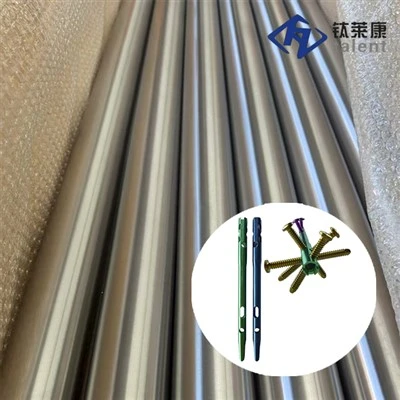
First, let’s get one thing straight: titanium bars absolutely can be threaded. The confusion comes from how different types of titanium behave, and the common mistakes that turn a simple threading job into a scrap of expensive material. Not all titanium is the same, either. The two most common grades we supply are Grade 2 (commercially pure titanium, the workhorse for general applications) and Grade 5 Ti-6Al-4V (the alloy used for aerospace and medical parts, 2x stronger than steel but far less ductile). Grade 2 is way easier to thread, but even Grade 5 can be done right—you just have to approach it differently than you would mild steel.
Let’s start with the science that makes threading titanium different. Titanium has a low thermal conductivity, which means when you cut into it, the heat from the tool tip doesn’t dissipate into the metal like it does with steel or aluminum. That heat builds up right at the cutting edge, melting the tool or work-hardening the titanium at the thread surface. Work-hardening is a big one: titanium gets harder the more you machine it, so if you take a rough, fast cut, you’ll end up with a surface that’s too brittle to hold threads, or the tool will just skip across the surface instead of cutting clean. Aluminum, by contrast, is soft, ductile, and conducts heat well, so you can thread it in a few passes with no special setup.
Another property to know: titanium has a high strength-to-weight ratio, but its modulus of elasticity is lower than steel. That means a threaded titanium bar will flex slightly under load, which can cause threads to strip if you don’t design the thread depth correctly. Too shallow, and the joint will fail; too deep, and you’ll weaken the bar itself. It’s a balance that fabricators have to get right, and it’s why I always advise new customers not to guess at thread specs on their first order.
Now, the how-to of threading titanium bars, based on what we’ve learned over a decade of supporting customers. First, tooling is non-negotiable. You can’t use the same HSS (high-speed steel) taps you’d use for aluminum. For Grade 2 titanium, you’ll want a carbide tap with a sharp, polished flute—polished flutes keep the titanium chips from sticking to the tool, which causes broken taps and damaged threads. For Grade 5, you need a coated carbide tap, usually with a TiCN (titanium carbonitride) or TiAlN (titanium aluminum nitride) coating to resist heat buildup. We also recommend using a thread lubricant specifically for titanium, not generic cutting oil. Lubricant reduces friction, which cuts down on heat and prevents galling—one of the most common headaches with titanium threading. Galling is when the titanium material welds itself to the tool, so you end up with torn threads instead of clean cuts; it’s 100% preventable with the right tool and lubricant.
Speed and feed rates matter too. Most fabricators default to high speeds to save time, but that’s a mistake with titanium. For threading, you want slow speeds—around 30 to 60 surface feet per minute (SFM) for carbide tools, half that for HSS. Feed rates should match the thread pitch, obviously, but err on the slightly lower side of the recommended range to avoid work-hardening. For example, if you’re cutting a 1/2”-13 UNC thread, a feed rate of 0.077 inches per revolution is standard, but for titanium, drop it to 0.07 inches per revolution to keep the tool from digging too deep too fast.
What about different threading methods? Tapping is the most common, but some customers use thread rolling. Thread rolling is actually better for many titanium applications, especially Grade 5. Rolling doesn’t cut material—it displaces it, so the thread grains stay intact, resulting in stronger, more fatigue-resistant threads. It also eliminates galling entirely, since there’s no cutting action. The catch? Thread rolling requires the bar to have a diameter that’s precisely 0.95 times the minor diameter of the thread—too big, and the roll won’t form correctly; too small, and you’ll end up with shallow threads. We help customers with that calculation all the time; it’s a quick check we include with every bar shipment, just to avoid delays.
Now, let’s talk about common mistakes we see customers make when threading our titanium bars. The first is trying to thread as a secondary operation without prepping the bar correctly. If a bar has a surface finish that’s too rough (like a hot-rolled bar left over from a forging run), that roughness will cause the tap to catch. We always supply our bars with a mill finish for general threading, or a precision ground finish for close-tolerance applications—we don’t cut corners on surface prep because we know it affects threading. The second mistake is not allowing enough length for the thread. A steel bar might need 2 threads for a joint, but a titanium bar often needs 3 to account for that slight flex. If you’re joining a titanium bar to steel, you also have to consider galvanic corrosion—threads should have a dielectric coating, or you should use a lock washer to insulate the two metals, otherwise the joint will fail over time.
I should also mention when threading isn’t the best choice, even if it’s possible. If you’re making a high-pressure aerospace component or a medical implant that needs extreme fatigue resistance, threading a solid bar might not be as strong as a forged bar with a threaded insert, or a machined thread form that’s rolled instead of cut. But for 90% of the applications our customers use bars for—like mounting brackets, industrial machinery parts, automotive fasteners—threading works perfectly, as long as you follow the right process.
As a supplier, we don’t just send bars out the door and wash our hands of it. We’ve built a library of thread specs, tooling recommendations, and speed/feed charts for every grade we carry, and we send that to every customer along with their order. Last year, a shop in Ohio reached out because they’d been breaking taps on Grade 5 bars they bought from another supplier, and they were convinced titanium was unthreadable. We sent them a sample bar, our recommended TiAlN-coated tap, and a step-by-step guide, and within a week, they were making 500 threaded parts a day with zero broken tools. That’s the kind of success we love to see, and it’s why we don’t just sell bars—we support our customers through the whole process, because we know how finicky titanium can be.
Another thing to consider: specialty thread types. If you need a custom thread, like a buttress thread for heavy load bearing or a trapezoidal thread for linear motion, we work with precision machinists to supply bars that are sized to fit. A lot of suppliers will sell you a standard bar and tell you to handle the threading yourself, but we partner with trusted fabricators to offer pre-threaded bars for customers who don’t have threading equipment in-house. That’s a big value add—no more waiting for a second operation, no more shipping bars back and forth, just a finished threaded bar ready to use.
Let’s circle back to the original question: “Can titanium bars be threaded?” The short answer is yes, but with caveats. It’s not as simple as threading a steel bar, but with the right tooling, lubricant, speed, and prep, it’s a routine operation for most fabricators. The key is knowing your titanium grade, planning for work-hardening and heat, and not cutting corners on process.
If you’re working on a project that requires threaded titanium bars, or you’ve had bad experiences threading titanium in the past, we’re here to help. Whether you need to source raw bars, get advice on tooling, or even order pre-threaded components, we can walk you through every step to make sure your parts turn out right. Don’t guess at thread specs or use generic methods—reach out, and we’ll share the knowledge we’ve built over years of working with titanium, so you can avoid the mistakes that turn a simple threading job into a costly headache.
Industrial Titanium Bars References
ASM International. (2008). Metals Handbook: Machining (10th ed.). ASM International.
Davis, J. R. (Ed.). (2002). Titanium: A Technical Guide (2nd ed.). ASM International.
Kissel, T. (2019). Threading Titanium: Best Practices for Fabricators. Manufacturing Engineering Magazine, 162(3), 45-51.
Baoji Tailaikang High-Tech Metal Materials Co., Ltd.
With abundant experience, we are one of the most professional titanium bars manufacturers and suppliers in China. Please feel free to buy titanium bars for sale here and get pricelist from our factory. For price consultation, contact us.
Address: No.1, Southeast Cross of Gaoxin Avenue and Fenghuang 3rd Road, High-tech Development Zone, Baoji City, Shaanxi Province, China
E-mail: sale@tlkjs.com
WebSite: https://www.tlkmetal.com/
